
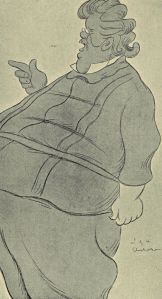
G.K. Chesterton (1874-1936)
“The Christian ideal has not been tried and found wanting. It has been found difficult; and left untried.“
During this time of enforced self-isolation, searching my bookshelves to find one of my books, bought and as yet unread, relegated to dusty shelves, I ran across a book subtitled, “Four Who Wrote in Blood.” The back cover further elaborating, “Four Unexpected Prophets Who Shine Light Into the Darkness.” What could be better? With anxiety, depression and suicide rates shooting skyward, maybe I could find answers.
Speak What We Feel: Not What We Ought to Say, shares Buechner’s (2001) reflections on literature and faith. The inclusion of Gilbert Keith Chesterton piqued my curiosity. I vaguely associated Chesterton with Christian apologetics, but I did not know much about him, nor had I read his original works.
To share Chesterton’s “vein-opening [when authors put] not just themselves into their books, but themselves at their nakedest and most vulnerable,” Buechner chose, The Man Who Was Thursday. I would need to read this book to fully integrate Buechner’s interpretation and analysis.
Thus began my dive into the life and writings of G.K. Chesterton.
Background
G.K. Chesterton, a British writer, philosopher, theologian, literary and art critic, has been called, “one of the most celebrated and reverently esteemed figures in modern literature.” He has also been referred to as “the prince of paradox,” making piercing points with proverbs, popular sayings and allegories. And to millions of Christians, Chesterton continues to be the erudite defender of their faith.
Chesterton’s expansive legacy includes influencing and inspiring Mahatma Gandhi to free India; which inspired other civil rights movements for freedoms around the world. George Orwell borrowed the date 1984 from one of Chesterton’s novels. And, poet T.S. Eliot wrote, Chesterton “did more than any man in his time … to maintain the existence of the [Christian] minority in the modern world.”
Born in London, Chesterton began professional life as an illustrator, proceeded to freelance art and literary critic, weekly columnist and radio talks for the BBC. Over his life time, Chesterton became a prolific writer with 100 books, 4,000 newspaper essays, hundreds of poems, five plays, five novels, and two hundred short stories.
His physical appears was quite striking, standing 6’4″ tall, weight 300 pounds, usually with a cigar in his mouth, walking around wearing a cape and crumpled hat, swordstick in hand with tiny glasses at the end of his nose. And usually he had no idea where or when his next appointment was. In fact, much of his writing was penned in train stations, as he usually missed the train he was supposed to catch.
G.K.’s marriage to Frances Blogg in 1901 lasted for a life time. A writer herself, Frances played a large role in his career as personal manager and amanuensis, writing or typing what he had written or dictated. Chesterton credited Frances with leading him back to Anglicanism, though he later considered Anglicanism to be a “pale imitation,” and converted to Catholicism.
Known as loving to debate, “Chesterton argued eloquently against all the trends that eventually took over the 20th century: materialism, scientific determinism, moral relativism, and spineless agnosticism.” Arguing against both socialism and capitalism, G.K. exhibited clear reasoning demonstrating both are enemies of freedom and justice in society.
As a political thinker, critical of both progressivism and conservatism, his views thus stated, “The whole modern world has divided itself into Conservatives and Progressives. The business of Progressives is to go on making mistakes. The business of the Conservatives is to prevent the mistakes from being corrected.”
Chesterton’s concern for the average man and woman clearly came through as he wrote about and defended “the common man” and his common sense, the poor, the family and beauty. Overcoming an early bout with depression, he became a thankful man, jotting down copious amounts of thanks for small everyday things in a notebook he kept with him.
Chesterton did face criticism, including being antisemitic, which he explained as his “desire to give Jews the dignity and status of a separate nation.“ He openly expressed his abhorrence of Hitler’s rule almost as soon as it started, speaking out with directness and frankness. Further, he attacked eugenics, sterilizing or segregating “mentally defective people.”
Contemporaries, such as T.S. Eliot, H.G. Wells, George Bernard Shaw, Bertrand Russell and Clarence Darrow debated and respected Chesterton’s works. Even some of those who disagree with him have recognised the wide appeal of such works Orthodoxy and The Everlasting Man, a book which led a young atheist named C.S. Lewis to become a Christian.
Books
Which brings us back to The Man Who Was Thursday: A Nightmare, and a quote from C.S. Lewis, whose books I have read and continue to re-read. Of the book, Lewis writes, “A powerful picture of the loneliness and bewilderment which each of us encounters in his single-handed struggle with the universe.”
Classified as a “metaphysical thriller,” brimming with detectives, duels, elaborate disguises, and unexpected chase scenes, the book centers around anarchists in London whose ranks get infiltrated. Christian allegory is noted throughout. The reader can’t help but notice social commentary exposing the moral relativism and nihilism of the day, commentary that perfectly aligns with our twenty-first century.
Chesterton suffered from a short time of depression during his college days. With this book and its double meanings, a small gleam of hope shines through “the world of wild doubt and despair which the pessimists were generally describing.”
The Chesterton book most people start with, Orthodoxy, has been called “the classic of Christian apologetics.” From the preface: the purpose is to “attempt an explanation, not of whether the Christian faith can be believed, but of how [the author] personally has come to believe it.”
I am slowly reading Orthodoxy, savoring each paragraph of wisdom and logic, a little stunned by the relevancy of his societal and cultural insights. Examples of paradox as a “supreme assertion of truth,” are replete throughout.
Wondering why it took me so long to find G.K. Chesterton, I am on to chapter three, “The Suicide of Thought.”
References:
Frederick Buechner: Speak What We Feel (Not What We Ought to Say), 2001
G.K. Chesterton: Orthodoxy, 1908
G.K. Chesterton: The Man Who Was Thursday: A Nightmare, 1908, Updated version 2014
Dale Ahlquist, The Society of Gilbert Keith Chesterton website
G.K. Chesterton: “Enormous Essayist, Poet, Author”: Christian History website
[In her retirement, CJ Austin continues to read, write, publish and share insights from her professional background (marriage and family therapy) with others. Contact: cjaustinauthor@gmail.com]
 Life Thoughts Today