
I was first introduced to Charles Williams while binge watching one of my favorite TV series, Inspector Lewis. In “Magnum Opus” (season 9, episodes 1&2, 2015), set in Oxford, England, as a case is solved, the detectives uncover a secret the victims all shared. To assuage their guilt, the group formed a cult, the “Companions of Coinherence,” reviving ideas of Williams by practicing the ritual of “substitution.”
Upon learning Williams was part of the Inklings (literary discussion group associated with C.S. Lewis and J.R.R. Tolkien at the University of Oxford), curious about his teachings which were shown to be outside of traditional orthodoxy, my curiosity was piqued and I began reading his novels.
Background
Charles Walter Stansby Williams (1886 – 1945), editor at Oxford University Press, is known as an important British poet, novelist, playwright, theologian and literary critic. The sonnets written while courting his future wife, Florence Conway, became his first book of published poetry. Williams is buried in Oxford, his headstone reading “Poet,” followed by, “Under the Mercy”, a phrase he often used.
Williams’ paradoxical spiritual views present confusion to believers of traditional orthodoxy. Referred to as a devoted member of the Church of England, believing in the importance of skepticism, he advocated the importance of being a “doubting Thomas” within an apostolic body.
Seemingly at odds with established church cannon, Williams was a member of the Fellowship of the Rosy Cross, and connected with Evelyn Underhill, associated with the Order of the Golden Dawn, secret societies studying and practicing occult, metaphysics and paranormal activities.
Gathering many followers and disciples during his lifetime, Williams proposed an order of Companions of the Co-inherence, those who would “practice substitution and exchange, living in love-in-God, truly bearing one another’s burdens, being willing to sacrifice and to forgive, living from and for one another in Christ.”
Referred to as one of the most gifted and influential Christian writers of the 20th century, readers of Williams’ “spiritual shockers” will find satire, romance, morality and glimpses of eternity. T.S. Eliot wrote introductions for his novels and described them as “supernatural thrillers,” exploring the “sacramental intersection of the physical with the spiritual while also examining the ways in which power, even spiritual power, can corrupt as well as sanctify.”
C.S. Lewis, said to be one of his greatest admirers, sharing “an enduring and fruitful friendship,” commented, “writing that sort of book in which we begin by saying, let us suppose that this everyday world were at some one point invaded by the marvelous.”
Novels in Review
Charles Williams’ books, much darker than the writings of C.S. Lewis, nevertheless contain much to ponder. His fantasies are set in a modern world, unlike J.R.R. Tolkien and many of C.S. Lewis’ novels. The author is also noted for multiple references to classic legends, in particular Arthurian.
Straying from traditional orthodoxy, Williams’ writings are controversial, especially to those without a firm grasp on traditional Christian tenets. The following two books are described as “Gothic-type Stories,” featuring multiple spiritual dimensions in which good and evil forces are unleashed on a naïve world.
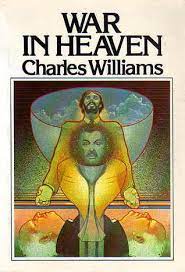
War in Heaven (1930), described as being an “unabashedly mystical and intellectual” tale, combines a murder mystery with a modern quest for the Holy Grail, while exploring the distinction between magic and religion, complete with occultic practioners.
Discovery of the Holy Grail, a chalice for “commonplace” partakers of Holy Communion, surfaces in a remote English country parish church, and becomes the source for exploits of an editor, a Duke and an Archdeacon, all with their own designs for this sacramental object; some trying to protect the vessel, others desiring to use it as a power source.
A back and forth battle between good and evil ensues with neither the villains nor the heroes able to control the vessel. As the agents of evil and good contend with each other, no one is what he or she seems to be. Rather, this force, beyond recognizable material or spiritual, is beyond domination.
As the celestial realm interfaces with earth, unexpected phenomena and black magic appear, at times making it difficult to tell each character’s intent. Throughout the book, each person is faced with consequential choices, choices which can mirror our own. Spoiler alert: good triumphs in the end.
Descent into Hell (1937), a provocative, classic metaphysical thriller in which a group of suburban amateur actors, affected by personal demons and terrors, explore their future, having to choose pathways that will lead to heaven or hell.
Battle Hill, a small community on the outskirts of London, is the setting for villagers preparing to stage a new play by the neighborhood’s famous resident, the writer Peter Stanhope, an academic so far removed from the world that he fetishises a woman to the extent that his perversion takes the form of a succubus. We also meet a doppelganger, the ghost of a suicidal laborer, and an old lady, Lilith, who invokes fantasies to raise demonic saccubuses to replace people.
The story centers on two people making diverse choices; one towards complete disconnection and the other towards connection with humans beings. The adventures take many twists and turns. As the powers of good and evil are released, there are times the assumed good is more scary than the powers of evil. In the end, the powers of good withstand the powers of evil and peace is restored to the village.
It would be difficult to miss the prominent theme of the book. Human beings who shut themselves up in their own narcissistic world are no longer able to love, or “co-inhere,” and the result is a veritable hell.
Williams’ Theological Concepts
I found reading Williams’ books curiously captivating, although a little difficult at times. The author is noted for using old terms in new ways and for combining words to create new terms. Having a deeper understanding of the following terms would be advantageous before reading.
I preface my comments here by saying I have only recently begun looking more deeply into William’s theological concepts and terms, sharing my understanding of his ideas to the best of my ability.
Co-inherence,Williams’ theological centerpiece, a concept he coined, “co-inherence,” can be thought of as an universal spiritual principle which works itself out in our physical, material realm through relationships with others; such relationships being essential for humanity.
Especially for Williams, co-inherence is a way of understanding the Body of Christ and the communion of saints in the belief that salvation is not solitary. Other people are necessary; “the thread of the love of God was strong enough to save you and all the others, but not strong enough to save you alone.”
One example given of the co-inherence of mankind with each other is the unity of God in the three persons of the Trinity. Another example, referenced from Romans 8:17, “Now if we are children, then we are heirs—heirs of God and co-heirs with Christ, if indeed we share in his sufferings in order that we may also share in his glory.”
Exchange, by which Williams means the process of living with each other by sharing tasks and responsibilities. Examples include people living in a community, members of a church, the body of Christ (I Corinthians 12:12-30), the empire in Arthurian poems of Williams, and Jerusalem as the city of God (Revelation 21).
Substitution, or Substituted Love, is the process of bearing the burden of another person through an act of love. Williams postulates, “we can quite literally take over the cares, anxieties and even the physical pain of another.” This he compares to the central mystery of Christianity by using as a model the substitutionary death of Christ on the cross.
Romantic Theology espouses that all worldly aspects of love reflect heavenly love and ultimately point the lover towards God. Williams describes falling in love as mystical, in which one sees his or her beloved just as they are seen through the eyes of a loving God.
By extension, Williams views the natural and social world (cultural, economic, ecological) functioning by interrelationships; mutual indwelling similar to the interdependency of Christ in us and we in Christ.
Controversial Teachings
For those coming from a traditional Christian theological perspective, as you can imagine, much criticism and debate abound. Several examples follow.
One example given is Mary the mother of Jesus. In the words of Williams, as the “Motherhood of the Incarnation,” this should be the function for all human kind, to emulate the co-inherent type of existence with occurred in her womb.
Personally, this is stretching my theological and conceptual cognition.
Another example of Co-inherence is in becoming “Inheritors of God, and fellow inheritors with Christ.” (Romans 8:17). We do this by accepting for ourselves and appropriating to others the sacrifice Christ made on the cross on our behalf. As Paul writes, “I have been crucified with Christ; and it is no longer I who lives, but Christ lives in me” (Galatians 2:20).
Further explained as, by accepting Christ’s death on the cross for ourselves we participate in his death (being made dead to self) and in his resurrected life (being made alive in Christ). It is an act of Co-inherence between ourselves and Christ that we share with others.
I think one has to be careful to not minimize the suffering of Christ on our behalf, not a “co” relationship, as we are not equal to Christ. Perhaps I have misinterpreted William’s intent.
Other examples of Co-inherence in the natural and spiritual realm include the two natures of Christ (human and divine), the presence of Christ in the Eucharist (however that is defined), the workings of society, all forms of love, and finally a woman physically bearing a child to the point of birth. All these Williams thought involved the working out of the idea of Co-inherence.
Substitution: the process of bearing the burden of another person through an act of love. In his writings, Williams’ stretches this concept to his belief in the substitutional love and replacement of sin by other humans.
We are told to share the joys and burdens of others, but care is needed to not imply that we, as humans, have the same capacity as the Divine Trinity.
Way of Affirmation, in which Williams favorably embraces asceticism and rejects the world as corrupt and evil, postulating we should think of the world as good, and transmute this goodness into a Christian vision of creation.
Yes, Christians should be a light to the world in affecting positive change. However, I personally believe that mankind is not inherently good. Examples include children needing guidance to overcome egocentricity and the trajectory of mankind on a personal level, as well as on a whole. We are given consciousnesses to prick our bad inclinations and it is up to us to choose how we will act.
In fact, I believe the problem with society today is that the vast majority have been led down the wrong path of believing people are intrinsically good. We all make choices, and unfortunately, not all people make good choices. This is a deep topic deserving of its own article in the future.
Concluding Thoughts
While interesting to contemplate, I find reading Charles Williams’ books uncomfortable at times and his theology dilatory. However, I believe sometimes a person should stretch outside his or her comfort zone and analyze closely the bedrock of one’s belief system.
As I contemplate Williams’ complex concept of spirituality, next up for me is, “The Descent of the Dove: A Short History of the Holy Spirit in the Church.”
References
War in Heaven, Charles Williams, 1930
Descent Into Hell, Charles Williams,1937
http://web.sbu.edu/friedsam/inklings/coinheretance.htm
[In her retirement, CJ Austin continues to read, write, publish and share insights from her professional background (marriage and family therapy) with others. Contact: cjaustinauthor@gmail.com]
 Life Thoughts Today