
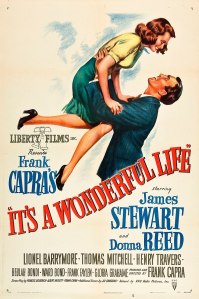
It’s a Wonderful Life
Just about every year about this time, I subject myself to watching the black & white classic, It’s a Wonderful Life, and each year as I identify so closely to George Bailey’s life path, I find tears forming for the man who sacrifices his dreams and ambitions to benefit others, eventually changing his priorities, surviving a crisis, and his life really does become wonderful.
Storyline
Reversing Charles Dicken’s, A Christmas Carol, in which Scrooge changes from miserly meanness to charity and gleefulness; here we see a good man who descends into despondency. George Bailey has given up on many of his personal dreams to help others in his family and in the community. On Christmas Eve, as he is facing a personal and financial crisis, with no hope in sight, he is thinking about ending his life.
Just in time, to George’s rescue comes Clarence Odbody, Angel 2nd Class. Through flashback vignettes, displaying life in which George was never born, we are treated to scenes showing how different life would be for the people and community of Bedford Falls under the thumb of the town miser Mr. Potter.
Backstory
Called an “American Christmas family fantasy drama,” the film, produced and directed by Frank Capra debuted in 1946, based on a short booklet, The Greatest Gift (Philip Van Doren Stern). The first film he made after returning from service in WW II, Capra did not intend the movie to be branded as a “Christmas picture,” rather, he desired the film to represent ordinary people who try their best to do the right thing for others.
Receiving mixed reviews, box office sales were disappointing and the film became a classic only after it was put into public domain without licensing or royalty fees.
It’s a Wonderful Life is now recognized by the American Film Institute as one of the 100 best American films ever made, and number one on the list of the “Most Inspirational American Films of All Time.” In 1990, the movie was added to the National Film Registry of the Library of Congress, designated as, “Culturally, Historically or Aesthetically Significant.”
Life Lessons
Having not achieved his dreams of leaving Bedford Falls, traveling the world, and becoming a great architect, George thinks of himself as a great failure. However, through an unusual gift, seeing life where he hadn’t been born, George understands that by staying in the community, he was able to help improve the lives of many people. These friends and family members became his true friends.
As George comes to the realization that relationships, often hidden, but developing all around him, are more important than what he thought he wanted out of life, may we also adjust our goals and how we spent our lives pursuing those goals.
Like George, may we all come to the conclusion that friends and family are what is important in life.
“No Man Is A Failure Who Has Friends“
[In her retirement, CJ Austin continues to read, write, publish and share insights from her professional background (marriage and family therapy) with others. Contact: cjaustinauthor@gmail.com]
 Life Thoughts Today