
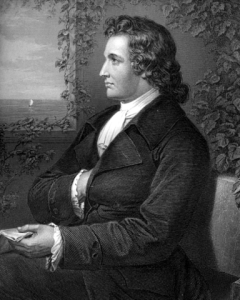
“A man should hear a little music, read a little poetry, and cultivate good thoughts every day of his life, in order that worldly cares may not obliterate the sense of the beautiful which God has planted in the human soul” (J.W. von Goethe, 1749-1832)
Having started our current compilation of articles with this quote, I became curious to learn more about Goethe (pronounced “Gur-ta”), a name I have come across many times, but a man I knew little about. Considered to be one of Germany’s greatest literary figures, Johann Wolfgang von Goethe’s writings include plays, poetry, literature, criticism, scientific treatises on botany, anatomy and color. Goethe’s influence on Germany is considered second only to Martin Luther’s.
Early Life and Education
Born into a Lutheran family, the von Goethes’ lived in a large house in Frankfurt, a free imperial city of the Holy Roman Empire. Early education by his father and tutors enabled Goethe to learn Greek, Latin, French, and Italian by eight years old. To satisfy his father, Goethe enrolled in law at Leipzig in 1765.
Goethe studied law from 1765 to 1768, but detested learning judicial rules by heart, preferring instead to attend poetry lessons. By August 1771, Goethe completed his academic degree and established a small legal practice. In his desire to make the legal system more humane, his inexperience led him to proceed too robustly in his first cases, he was reprimanded, and lost further ones which prematurely terminated his career as a lawyer after only a few months.
Adult Life
Goethe wrote throughout his law studies and days as an editor of a literary periodical. With the success of his first novel, The Sorrows of Young Werther (1774), Goethe moved to Weimar and stayed for the remainder of his life, serving on the Duke’s council.
At one point, Goethe left Weimar without telling anybody, taking an assumed identity. He traveled to Italy and Sicily for a time of “reawakening,” studying art and poetry, contemplating philosophical concepts, and experiencing relationships with various women.
In 1806, Goethe married Christiane Vulpius, legitimizing their long relationship. Of their five children, only their oldest son, August von Goethe survived into adulthood.
Goethe met with Napoleon in 1808, the two discussing writings of Voltaire and Goethe’s books, both favorably impressed with the other.
Scientific Contributions
Although his literary work has attracted the most interest, Goethe was also deeply involved in studies of natural science, colour, evolution, linguistics and mineralogy. His private collection of 17,800 mineral and rock samples was the largest in Europe and the mineral goethite (iron oxide) is named for him.
Goethe is credited with developing the concept of nature dubbed “holism,” the sense “that the universe is a living organism that develops and grows.” This contrasted with the prevailing Enlighten-ment view of understanding nature as a “mathematical and spiritless mechanism.”
By studying an elephant’s skull, Goethe was the first to prove the existence of the intermaxillary or “Goethe’s bone,” when the prevalent view was that this bone did not exist in humans.
Interested in barometer readings, using the Torricelli principle, Goethe popularized the “Goethe barometer,” showing evidence that barometric levels vary in different zones and at different altitudes above sea level.
Goethe considered his most important work to be his Theory of Colours. Published in 1810, color is described as the interplay of light and darkness through a turbid medium; the light spectrum observed through a prism.
His work influenced many others, including, Darwin and Nikola Tesla, who conceived the idea of rotating magnetic field and alternating current while listening to his favorite poem, Goethe’s Faust.
Philosophical and Spiritual Underpinnings
Goethe’s philosophic writings, in aphoristic style, influenced many thinkers, including Hegel, Schopenhauer, Kierkegaard, Nietzsche, Carl Jung, and Ralph Waldo Emerson. Goethe, through his fascination with the world as he experienced it and his willingness to examine his beliefs when confronted with new insights continues to appeal to students of philosophy.
With phrases such as “All finite beings exist within the infinite,” Spinoza’s influence is well documented. From Spinoza, Goethe adopted the view that “God is both immanent with the world and identical with it,” which is the view of pantheist such as Albert Einstein. Goethe was also a Freemason, frequently referring to masonic themes of universal brotherhood.
Goethe’s early faith was shaken by news of such events as the 1755 Lisbon earthquake and the Seven Years’ War, and his unorthodox religious beliefs that developed led him to be referred to as “the great heathen” among the authorities of his time.
Goethe described himself as “not anti-Christian nor un-Christian, but most decidedly non-Christian.” Described as a freethinker, Goethe believed a person could be inwardly Christian without following any of the Christian church dogma. He distinguished between Christ and the tenets of Christian theology, criticizing established church history as a “hodgepodge of fallacy and violence.”
Literary Contributions
Writing during a period referred to as Sturm und Drang (romanticism, and classicism), Goethe had a great effect on the nineteenth century, originating many ideas later which became widespread. His influence can be seen in drama and opera, his poetry being set to music by many major composers, including Mozart, Beethoven, Liszt and Mahler,
Goethe’s writings include novels which are part of great European literature, classic memoirs describing his childhood and his travels, and essays on scientific subjects ranging from the theory of colors to the morphology of plants.
The Sorrows of Young Werther, a story about unreciprocated love, published in 1774, brought worldwide fame. The book addresses depression and discontent, and believed to inspire suicidal behavior, was banned in several countries.
Goethe poetically and artistically addressed human sexuality in a time when privacy was the normative. Some of his works were kept from publication due to the content of suggestive passions and acts.
Faust
Perhaps Goethe is best known for his version of Faust, the classic German legend in which the hero, Doctor Faustus, highly successful, yet dissatisfied, sells his soul to the devil in exchange for unlimited knowledge and power, thus showing he prefers human knowledge to the divine.
In Goethe’s version, the devil approaches Faust. Rather than asking for magic powers or supernatural knowledge, what the doctor asks for is experience; a life lived at fever pitch, “a frenzied round of agonizing joy, of loving hate, of stimulating discontent” with the condition the devil may take his soul whenever he grows too contented with life.
After signing the contract, Faust first uses his power to seduce a teenage girl which destroys her family. In the second part, the “spirits of the earth” forgive Faust, and with the devil, they navigate the world and politics, taming the forces of war and nature so that Faust knows a little moment of happiness.
The angels intervene in Faust’s soul due to God’s grace, even though his errors are not condoned, because Gretchen has forgiven and interceded for Faust, despite the devils insisting he be consigned to the “Eternal Empty.”
This is another departure from the legend and earlier books, ballads, dramas and puppet plays, in which Faust is forever dammed for preferring human to divine knowledge.
Goethe’s hybrid play / extended poem version first published in 1808 with the final version published after his death. It has been theorized Faust represents Goethe’s life and work. Not being satisfied with what life has to offer, he demanded “ever-stronger draughts of emotional intoxication,” especially love.
Ending Thoughts
In 1832, at the age of eighty-two, Goethe died from heart failure. His last words are reported to be, “Mehr Licht!” (More light!), from which one could conclude either his vision was dimming and he wanted the drapery opened, or as some have suggested, it was a metaphor from a writer who spent his life seeking illumination and understanding of the human condition.
Considered one of the greatest genius in Germany history, Goethe is greatly neglected in the English speaking world, even though his philosophical ideas continue influencing the trajectory of our culture, often deviating from traditional Christianity tenets. To affect our culture, it is important to be knowledgeable in order to converse intelligently with our fellow travelers.
What I thought would be a quick summary of a person I was fascinated by, quickly branched out into deeper literary and philosophical areas which I will continue to pursue. While I believe we should be reflective people, critiquing inherited dogmas in light of new insights and information, a person must be deeply grounded in bedrock convictions of truth and faith.
References:
https://iep.utm.edu/goethe/
https://www.newyorker.com/magazine/2016/02/01/design-for-living-books-adam-kirsch
[In her retirement, CJ Austin continues to read, write, publish and share insights from her professional background (marriage and family therapy) with others. Contact: cjaustinauthor@gmail.com]
 Life Thoughts Today