

We are living in an era in which, as we search for truth, discerning peoples’ motives is increasingly difficult. I’ve recently stumbled across a chart (thank you J. Credence) categorizing a person’s world view (moral and ethical perspective), which is the core for his or her verbalizations and actions.
This simple grid chart, shared and widely viewed on social media (according to Google Search Trends) is a way to categorize much more than people and their intentions. Going viral, its use has morphed into widely diverse areas with accompanying debate as to the validity of its usage.
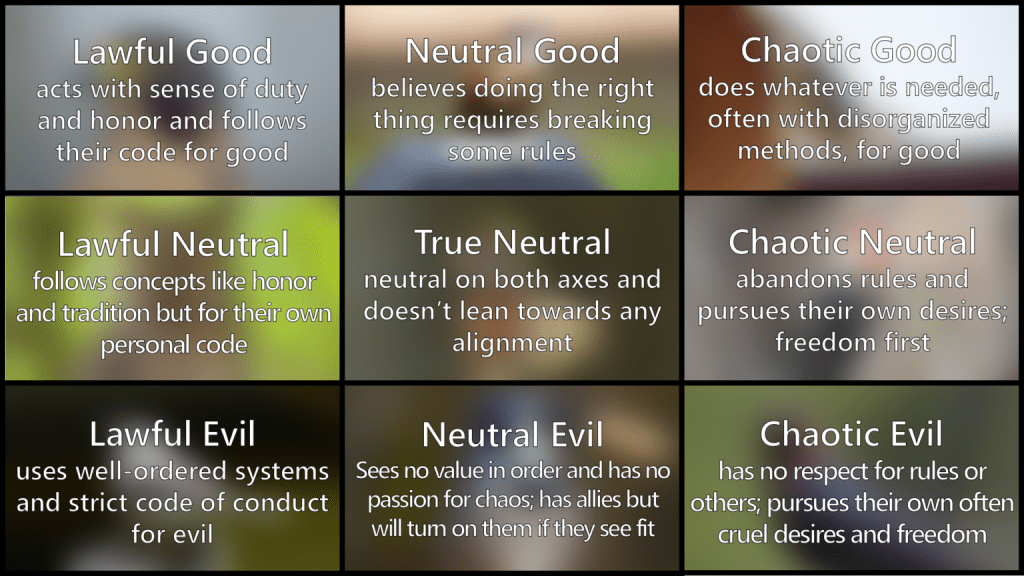
Alignment Charts
Referred to as an “alignment chart,” the concept derives from the role playing game, Dungeons & Dragons, in which the characters and creatures are categorized by their moral perspective. This guides decision making throughout the game, keeping behaviors consistent and avoiding random acts. Penalties are incurred for switching alignments in the midst of a game, or for acting egregiously out of character.
About D&D
First published in 1974, the fantasy role-playing game quickly became popular, many decrying the “overtones of satanism and witchcraft.” In the 1989 edition, some of the demon references removed, combined with reimaging as a war and strategy game, emphasizing developing characters and exploring their choices, the popularity continued to skyrocket.
From the D&D Handbook
The chart delineates two choices for each character. (detailed descriptions: http://easydamus.com/alignment.html)
First Choice
– Good means leaning toward altruism and personal sacrifice
– Evil means harming and oppressing
– Neutral wouldn’t kill somebody for no reason, but wouldn’t protect anybody for no reason either.
Second Choice:
– Lawfulness “implies honor, trustworthiness, obedience to authority, and reliability. On the downside, lawfulness can include closed-mindedness, reactionary adherence to tradition, judgmentalness, and a lack of adaptability.”
– Chaos “implies freedom, adaptability, and flexibility. On the downside, chaos can include recklessness, resentment toward legitimate authority, arbitrary actions, and irresponsibility.”
Handbook Recommends:
– Good and lawful alignments
– Evil characters are distracting and disruptive
– Neutral characters are untrustworthy (“they are honest but can be tempted into lying or deceiving others if it suits him/her”)
Popularity
The growth of alignment charts has become such that, rather than associating with the game, the grid is being used to sort just about everything: politicians, people, companies, food, fonts, computer platforms, etc. And, in keeping up with popular vernacular, the categories have become a common cultural reference point as seen on all major social networks where you can notice people as well as inanimate objects being described as “chaotic good” (cool, but disrespects authority) or “lawful evil” (loyal, but within his/her own code of conduct).
With real world events and reliability of information fluxuating, people searching for a way to align and make sense of their experiences, have found the alignment chart useful to bring some stability.
Limitations
It is appealing to pigeonhole a decision into a box. However, some drawbacks have been raised. Human behavior is more complicated, and designating people or things as good or evil and lawful or chaotic is often vague at best.
Applied to social media platforms, judgement can become impossible because of confusing scenarios and unpredictable situations, making moral judgments reductive. And it must be recognized that these types of charts push people to respond with their desires (way they wish things to be) which taints the results.
While useful in virtual worlds where moral decisions are outlined in a clear chart and there is a referee who can declare violations and penalize players, in the corporeal world, behavior and ways people react is messy and cannot be confined to a nine grid chart.
Something To Think About
We live in a world where trust in institutions and each other has significantly declined, and bringing some clarity to this world is very appealing.
Making judgements and putting people or things into boxes all neatly sorted has great appeal. The underlying premise, that life is made up of logical choices, tidies up messy and often illogical experiences, helping a person navigate current life situations.
It must be said that logic is only one component in evaluating people, positions and choices. We are also given intuition, previous life experiences, researching information, body language, and, for people of faith, spiritual guidelines and access to the Father of all.
In the end, I personally find the chart interesting in assessing all that life hurls. Maybe you will too.
[In her retirement, CJ Austin continues to read, write, publish and share insights from her professional background (marriage and family therapy) with others. Contact: cjaustinauthor@gmail.com]
 Life Thoughts Today