

Beowulf, required reading for many of us in high school, is an Anglo Saxon epic tale touted as purely pagan work, hailing from England. The primary reference for this article is, Beowulf: a Prose Translation Introduction (Penguin Classic, David Wright). I find it not only the easiest to understand, but also the most thorough and comprehensive of the several Beowulf translations.
Facts
Beowulf is the oldest known Anglo Saxon epic, author unknown, from approximately the sixth century. While founded in England, the epic is primarily the story of a Thane named Beowulf, prince and eventually king from what we now call Southwestern Sweden.
Archaeological Discovery
A ship, Sutton Hoo, remarkably similar to the one described in detail in Beowulf, has been unearthed. Amazingly, it is made of wood from the Middle East.
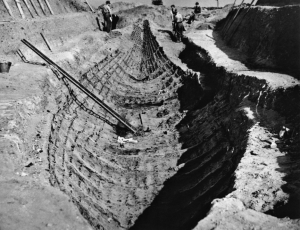
From around the seventh century, the ship has bitumen from the middle east on its hull.
A “Mead Hall,” like the primary setting of the story has also been discovered.
Characters
Through my research I have found that Beowulf is in fact represented in a historically accurate sixth century Christian record of the rise to power of a King of Geatland, named Beowulf.
In fact, every character in this epic tale is cross verified matching up to historical figures.
High Hrothgar, the king of the Danes, was plagued by a pestilence of giant size.
Grendel, according to the text is a descendant of line of Cain. He came nightly to destroy the people in the mead hall, with his godlike strength and power, on a serial murder style killing spree.
The text describes Cain’s line as follows:
The grim demon was called Grendel, a notorious ranger of the borderlands, who inhabited the fastnesses of moors and fens. This unhappy being had long lived in the land of monsters, because God had damned him along with the children of Cain. For the eternal Lord avenged the killing of Abel. He took no delight in that feud, but banished Cain from humanity because of his crime. From Cain were hatched all evil progenies: ogres, hobgoblins, and monsters, not to mention the giants who fought so long against God – for which they suffered due retribution.
And out of the curse of his exile there sprang Ogres and elves and evil phantoms And the giants too who strove with God time and again until He gave them their final reward.
One must ask, “Why would a hero prince help another land, not his own, against such a plague?” We are taught in academia that it was for glory and honor. But let’s take a closer look.
We do know the early Viking people generally came just to conquer others. This would be logical so that Beowulf would make a name for himself. But this isn’t what the text says. On the contrary, the text even expands on the pagan beliefs of King Hrothgar’s people versus the Geats’ beliefs, to which Beowulf is connected.
When put into context, it is clear that Beowulf’s attributes his heroic prowess to the Lord God Almighty.
This and much more information I will be sharing.
[In addition to being mother, wife, daughter, sister, friend, etc., J. Credence is a Google Marketing Expert, owning Mavenite.Media, of which she is director of Media and Marketing. With her husband, she parents three young kids with special needs, held together thanks primarily to Jesus, by being Bible believing Jesus Followers, and a dash of grit on both their parts. Contact: J.Credence@mavenite.media]

